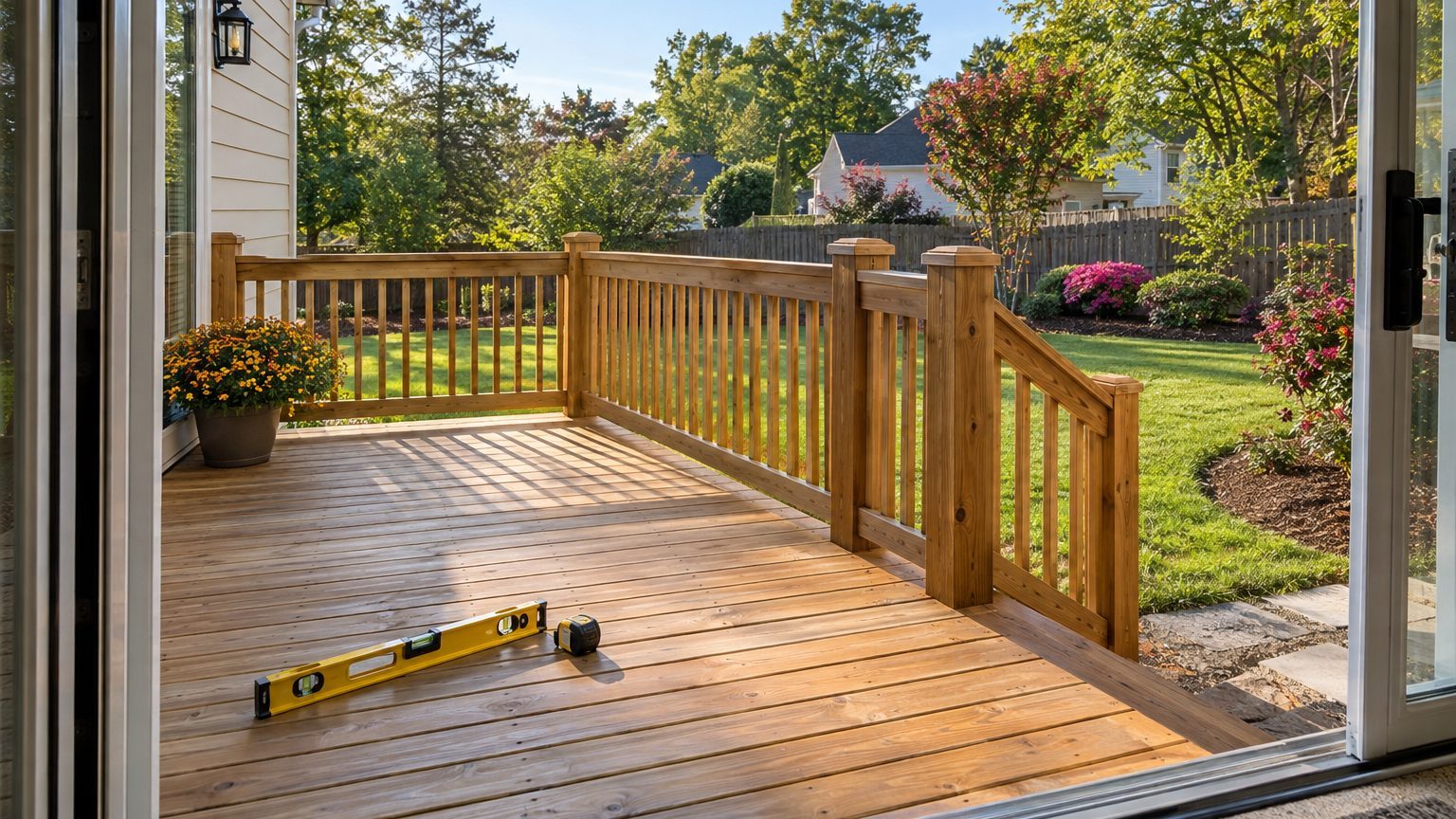
Georgia has no single statewide deck code. Local governments enforce the 2024 International Residential Code (IRC) with Georgia Amendments, which the Georgia Department of Community Affairs (DCA) made effective January 1, 2026, and each county or city runs its own permit process. As a baseline, a deck more than 30 inches above grade needs a guard at least 36 inches high, with openings small enough to stop a 4-inch sphere. Most jurisdictions require a permit for attached or elevated decks, so call your building department before you buy lumber.
What Are the Deck Railing Height Requirements in Georgia?
A deck can go without a guard (the code’s term for a railing) while the walking surface stays 30 inches or less above the grade below. Inspectors measure the drop at the lowest point near the deck edge. If the yard slopes and the surface is 28 inches high at the house but 33 inches at the far corner, the deck needs a guard.
Guard height runs from the top of the decking to the top of the rail, not from the joists. The minimum is 36 inches on residential decks. On stairs, the guard must reach at least 34 inches, measured from the stair nosing (the front edge of each tread). Guards must also carry a 200-pound concentrated load, so a rail post that flexes under a hard push will fail inspection even if the height is right.
Openings must reject a 4-inch sphere. Setting balusters at 3 1/2 inches of clear spacing gives you margin for lumber that shifts as it dries. Stairs get their own limits: the triangle formed by the tread, riser and bottom rail may not pass a 6-inch sphere, and the open side of a stair guard may allow a 4 3/8-inch sphere.
Stair handrails sit 34 to 38 inches high and must be graspable. Gwinnett County’s final inspection checks for a handrail where a stair has four or more risers. Stairs must be at least 36 inches wide, with risers no taller than 7 3/4 inches and treads at least 10 inches deep.
Do You Need a Permit to Build a Deck in Georgia?
In practice, yes. The state deleted Chapter 1 of the IRC (scope and administration) from its adopted version, so permit rules are set by your county or city. A permit is required when a deck attaches to the house or sits more than 30 inches above grade. Gwinnett County requires a permit before any land disturbance for a deck on a one- or two-family home, and Atlanta, Cobb County and DeKalb County also treat decks as permitted work. Replacing the guardrail or stairs on an existing deck may require a permit too, so ask your building department first.
Exemptions are narrow. The IRC’s model language (R105.2) exempts a deck of no more than 200 square feet, no more than 30 inches above grade, not attached to a dwelling and not serving an exit door. Attach it to the house and the exemption is gone. Some places use a different trigger: Macon-Bibb County requires a permit above $2,500 in project value and wants zoning compliance first.
Only a homeowner or a licensed contractor can apply. Expect to submit a site plan, framing layout, and footing and ledger details. Gwinnett asks for a Deck Addition Location Plan, and homes on septic systems need health department sign-off first. Permit fees vary widely by county and project value, and Cobb County adds a separate site plan review fee for decks.
Many jurisdictions inspect at least at footings and at final. Gwinnett adds an electrical rough-in inspection when there is wiring, and Macon-Bibb adds a framing and ledger inspection before decking goes down. Leave the framing uncovered until it is signed off.
What Are the National Deck Building Codes?
The IRC, published by the International Code Council, is the model code. Georgia’s DCA adopts it as the state minimum standard, with amendments. Local governments then enforce it and add their own zoning, setback and permit rules, so a county can add requirements but cannot go below the state code. An HOA sits outside the chain: its covenants can ban a deck the county would approve, and a county permit does not substitute for HOA sign-off.
The IRC deck provisions live in R507, with guards in R312 and stairs in R311.7. Footings must bear on undisturbed soil below the local frost line. The ledger, the board that fastens the deck to the house, must be bolted or lagged through the band joist with flashing, never held by nails alone. Georgia’s amendments revise the R507 figures for lag-screw and bolt placement and for lateral-load attachment. They also require 1/2-inch lag screw holes to be predrilled in two steps: 1/2 inch through the ledger, then 5/16 to 3/8 inch through the band joist.
| Requirement | Baseline (IRC) | What to confirm with your Georgia building department |
|---|---|---|
| Guard required above | 30 inches above grade | Where the inspector measures grade, especially on sloped lots |
| Minimum guard height | 36 inches from walking surface to top of rail; 34 inches on stairs from nosing | Whether stair guards are measured from the nosing line |
| Maximum opening | 4-inch sphere must not pass | Whether cable, glass or metal infill systems are accepted |
| Stair handrail height | 34 to 38 inches, graspable | How many risers trigger a handrail locally |
| Ledger attachment | Bolted or lagged with flashing, no nails only | Flashing and fastener details required on your drawings |
| Footing depth | Below local frost line and on undisturbed soil | Required depth, footing size and when the footing inspection happens |
How Do Local Georgia Deck Codes Vary by County?
Frost depth is the clearest example. Frost depth is set locally: some North Georgia jurisdictions list about 5 inches, and the 12-inch minimum footing depth usually governs, while other counties, such as Macon-Bibb, set their own footing requirements. Setbacks come from zoning, so they differ by lot and district. Atlanta, Fulton, Gwinnett, Cobb and DeKalb counties, and Macon-Bibb each publish their own application forms, drawing requirements, fee schedules and inspection stages. Coastal and flood-zone properties can add floodplain review, and historic districts can add design review.
Before you buy materials, call or visit the building department for your address. Be sure you have the right office: some cities run their own departments separately from the county. Ask these questions:
- Is a permit required for my deck’s size, height and attachment, and is there a value threshold?
- What is the minimum footing depth and size here, and will you inspect before concrete?
- What are the setbacks for my lot, and is zoning approval needed first?
- Which drawings do you need, and what are the fees and plan review time?
- Which inspections are required, and can I apply as the homeowner?
Check your HOA covenants separately, then request a utility locate. Georgia 811 states that mechanized digging requires notice at least 48 hours but no more than 10 working days ahead, and it encourages calls for hand-dug deck post holes too. Call 811 or file at georgia811.com, then confirm every utility has responded before you dig.
Frequently Asked Questions
How much does a deck permit cost in Georgia?
Fees vary widely by county and project value, from a few tens of dollars to several hundred. Ask your department for the current fee schedule, since counties revise them.
Does a deck need an inspection in Georgia?
If it needs a permit, yes. Do not pour concrete until the footing inspection is approved, and do not cover the framing until it is signed off.
Can a homeowner pull their own deck permit in Georgia?
Yes, though some offices, such as Macon-Bibb County, ask for contractor license information on structural work, so confirm owner-builder eligibility with your department first.
How deep do deck footings need to be in Georgia?
The minimum is 12 inches below grade, on undisturbed soil, and deeper wherever your local frost line or soil requires. Footing size depends on the loads and soil, so follow the sizes on your approved plans. DCA’s prescriptive deck details also require footings within 5 feet of the house wall to bear at the same elevation as the house footings.
Sources: dca.georgia.gov