Capped composite decking is projected to last 25 to 30 years with basic cleaning, and some manufacturers claim more. That is roughly double the 10 to 20 years of a maintained pressure-treated pine deck. Three different numbers hide behind that answer. The service-life claim is what a manufacturer says the product should do. The warranty term is a legal promise with exclusions and a payout that shrinks over time. Field experience is what decks do under your trees, your snow load and your cleaning habits. Trex’s warranties run 25 to 50 years depending on the line, and the International Association of Certified Home Inspectors (InterNACHI) lists composite decking at 8 to 25 years. None of these describes the wood framing underneath, which can wear out before the boards do.
How Long Does Composite Decking Last Compared to Wood?
On manufacturer projections, capped composite should outlast the wood options in the table below, although the top of the cedar range comes close. Ranges are typical rather than guaranteed, so check current figures against the manufacturer’s literature and American Wood Council or USDA Forest Products Laboratory guidance before you buy.
| Material | Typical lifespan | Main way it wears out | Upkeep | Typical warranty |
|---|---|---|---|---|
| Pressure-treated pine | 10 to 15 years average; 15 to 20 when maintained | Moisture, UV and insect damage: cupping, splitting, rot | Sealing or staining on a cycle; reseal cut ends | Limited warranty from the treater against rot and insects; term set by the treater |
| Cedar | 20 to 25 years with regular care | Same three threats, slowed by naturally decay-resistant heartwood | Sealing or staining to hold color and block moisture | Sold by grade, without a long-term performance warranty |
| Redwood | Comparable to cedar at a similar grade and climate | Surface weathering and moisture at the underside and cut ends | Sealing or staining | Sold by grade, without a long-term performance warranty |
| Older uncapped composite | Shorter than capped boards; depends on moisture exposure and cleaning | Exposed surface absorbs moisture, stains and grows mold | Dedicated composite cleaner twice a year; no pressure washer | Varied by line and era; read the original document |
| Modern capped composite | 25 to 30+ years projected; Trex warranties run 25 to 50 by line | Surface staining left uncleaned, scratches, tired framing below | Occasional soap-and-water cleaning | Trex: 25, 35 or 50 years residential |
| PVC | Manufacturers claim the same 25 to 50 year band as high-performance composite | Scratches and movement with temperature | Soap-and-water cleaning | Trex Refuge: 50 years; other brands vary |
Wood and composite fail in different ways. Wood loses to moisture, UV and insects, and the damage usually starts at the underside and the cut ends. Capped composite wraps a wood-fiber and plastic core in a polymer shell, and Trex’s warranty text promises boards that will not split, splinter, rot or suffer termite or fungal damage. What ends a capped deck is stains left to set, surface damage, and trouble in the structure beneath.
How Long Do Composite Decks Last?
A deck runs on three clocks: boards, framing and fasteners. The framing is usually pressure-treated lumber, so it can age on a wood timeline and wear out first, even when the boards above it look new. Screws and hidden clips (the concealed fasteners that grip the board edges) sit where water collects, at the tops of the joists. Self-adhesive joist tape, a strip applied over the joist top, keeps water out of the screw holes and is worth adding whenever you re-board.
Board generation matters as much. Capped boards carry a shell that resists moisture, stains and mold. Uncapped boards, such as the early Accents and Origins lines, installed before about 2009, have no shell, absorb dirt and water, and should never see a pressure washer.
Site conditions shift the outcome. Shade and humidity keep boards damp, which feeds mold on the pollen and dirt that settle in the texture. Freeze-thaw cycles push trapped water into joints and around fastener heads. Heat and UV drive expansion, color change and surface wear, and dark boards run hotter underfoot. A deck low to the ground in a damp corner of the yard ages faster than a raised, open one.
Poor installation is a common cause of early trouble. Gaps that are too tight leave boards no room to expand, so they buckle. Skirting or soil that blocks airflow keeps the underside wet. Trex’s warranty excludes conditions caused by improper installation, including improper gapping. The right gap depends on the board and the temperature on install day, so read the guide for your exact line.
How Long Does Trex Decking Last?
Trex sells its decking in three warranty tiers: 25 years for Enhance, 35 years for Select, and 50 years for Transcend, Transcend Lineage and Signature. Refuge, its PVC line, also carries 50 years. These are warranty terms, not life-expectancy figures: a 50-year warranty is a legal term and does not promise a 50-year deck.
The warranty splits into structural and appearance coverage. Structural coverage means the boards are free of defects and do not split, splinter, rot or suffer termite or fungal damage. Fade coverage allows a color change of no more than 5 Delta E units (the standard measure of color difference) for 25 years, then no more than 15 for the rest of the term. Stain coverage covers food and beverage spills, but mold that is not cleaned within one week of first appearing is excluded.
Payout shrinks with age. A claim made in year 11 or later is prorated. On the 25-year tier, recovery starts at 80 percent for years 11 to 13 and falls to 10 percent for years 23 to 25. The 50-year tier pays 90 percent through year 16 and 10 percent for years 43 to 50.
Exclusions matter as much as the term:
- Improper installation or ignoring Trex’s guidelines, including gapping.
- Commercial use, which carries a 10-year term on Trex decking lines.
- A damaged or punctured surface, which is not covered.
- Staining from dirt, grease or oil, and ordinary wear and tear.
Real-world results depend on generation. Shell-protected boards have been on decks for about two decades at most, so claims past that are projections. Pre-2009 uncapped Trex behaves differently: it needs a composite cleaner and no pressure washing. Check the exact line and the date on your warranty document.
How Long Should Composite Decking Last?
Budget on the field number, treat the warranty as insurance against defects, and read the manufacturer’s service-life claim as the best case. Capped boards in a ventilated, well-drained deck with clean gaps should reach the 25 to 30 year range. The framing decides whether that happens.
These signs mean the deck is near the end of its life, or at least needs a closer look:
- Bounce or soft spots underfoot, which point to joists, not boards.
- Boards that rock, sag between joists, or have split ends.
- Rusted or backed-out screws with rust streaks around the heads.
- A fuzzy, chalky or rough surface, or mold that returns within days of cleaning.
- A railing post that moves.
The repair decision follows the framing. Swap individual boards when damage is limited to a few boards and the joists under them are firm. Resurface when boards are worn across the whole deck but the framing passes a screwdriver probe with no soft spots, because resurfacing keeps sound framing and replaces only the surface. Rebuild when joists are soft, posts or the ledger (the board fastened to the house) are compromised, or connectors are corroded widely. New boards on tired framing only restart the boards’ clock.
How Do You Make Composite Decking Last Longer?
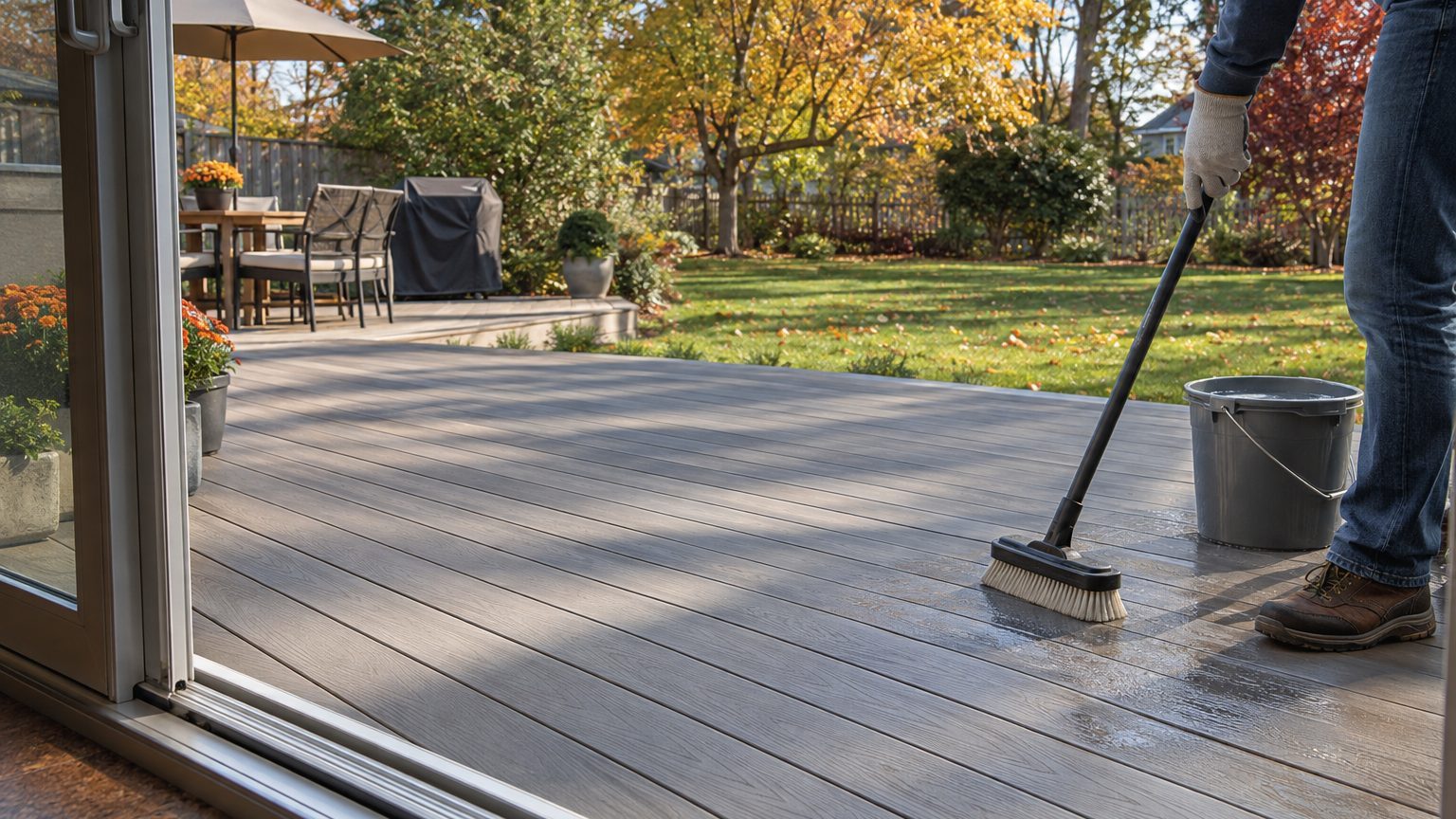
Sweep regularly and wash with warm soapy water and a soft brush in spring and fall. Pressure washing is optional on capped boards. Stay under 3100 psi, use a fan nozzle and hold it at least 8 inches from the surface; 1500 psi is adequate for routine cleaning. Do it no more than once or twice a year. Chlorine bleach, wire brushes and too much pressure can discolor or scratch composite.
Mold feeds on debris, so keep leaves and grit out of the gaps and clean grease spills right away. Mold left more than a week falls outside the Trex warranty. Keep planters on feet so water cannot pool beneath them, and fix any spot where water stands after rain.
Use felt pads under furniture legs and keep grill and fire-bowl heat off the boards, since direct flame and embers can melt or mark the shell. For snow, use a plastic shovel. Trex’s care guide allows calcium chloride or rock salt on ice; rinse residue off when practical.
Twice a year, spring and fall, run this inspection:
- Probe joists and beams with a screwdriver, especially near the ledger and posts, and flag any soft spots.
- Press down on boards and walk the deck to find loose or rocking ones.
- Check screws and hidden clips for rust, backed-out heads and stains around them.
- Rake debris from the gaps and clear leaves from under the deck.
- Confirm skirting or lattice is not blocking airflow and that soil has not built up against the framing.
- Look for pooled water and for mold returning in shaded areas.
Frequently Asked Questions
Can you pressure wash composite decking?
Yes, on capped boards. Stay under 3100 psi, use a fan tip and keep the wand at least 8 inches away. Never pressure wash older uncapped boards, because pressure can permanently damage them.
Does composite decking get moldy?
It can. Mildew grows on the dirt and pollen that settle on the boards, especially in shade. Capped boards resist it better than uncapped ones, but Trex’s warranty excludes mold that is not cleaned within one week of first appearance.
Does composite decking warp or crack in extreme heat or cold?
Capped boards expand and contract with temperature, which is why installers leave gaps sized to the board and the install-day temperature. Warping and cracking usually point to tight gaps, poor support or blocked airflow. Splitting is also a defect that Trex’s structural warranty covers.
Is the Trex warranty transferable if I sell my house?
For residential decks, the warranty can be transferred one time, within five years of the original purchase date. The term still counts from that original date, so a transferred 25-year warranty does not restart.
Sources: woodworkingadvisor.com | monkeyfence.com | pwhomeimprovement.com