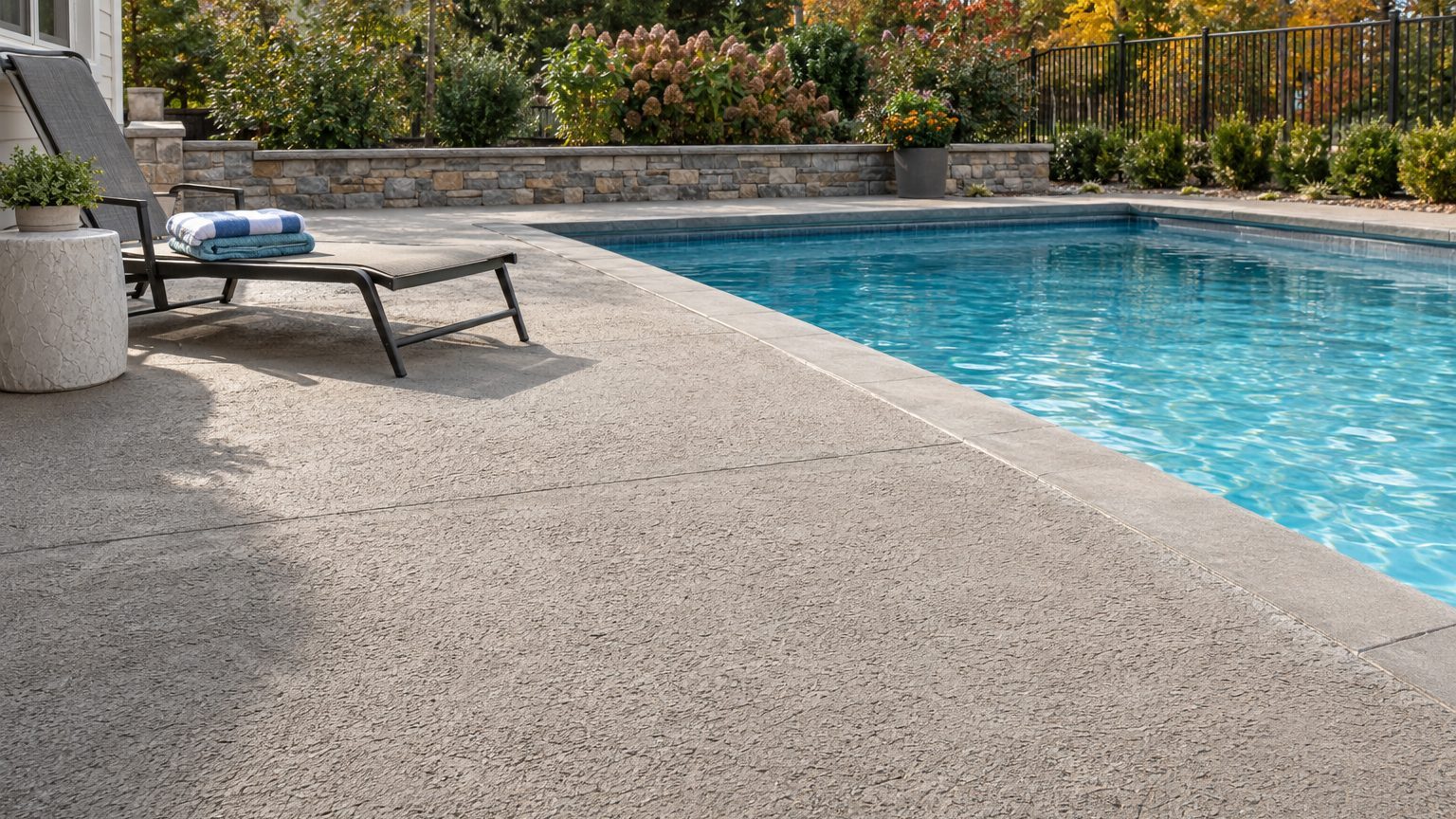
A spray-texture or knockdown cement overlay, a stamped or decorative overlay, and an acrylic cool deck coating cover most concrete pool decks. Each one goes over sound, clean concrete, and none of them fixes a slab that moves. Pool deck resurfacing averages $3.00 to $5.00 per square foot, according to SKIN Microplaster, against $6.00 to $10.00 per square foot for a new concrete pour. A confident DIYer can handle a small, sound deck with a roll-on or spray-on system. Large, damaged or stamped jobs belong to a pro.
What Are the Best Pool Deck Resurfacing Options?
Pick by what the deck needs most: grip, cooler footing or looks. A spray-texture or knockdown overlay is a thin cementitious layer sprayed on, then flattened with a trowel. The coarse surface grips wet feet, and it is often one of the more budget-friendly choices. Stamped overlays are thicker and carry patterns, but the sealer needs a non-slip additive or the surface turns slick when wet. Acrylic cool deck coatings are rolled or sprayed on in thin coats with reflective pigments. Paver or tile overlays suit a sound slab and a bigger budget, but they raise the deck height, so check the transition at coping, skimmer lids and the sliding-door threshold.
Thickness matters for cracks and uneven spots. SUNDEK coatings add just under a quarter-inch, and its blending overlay goes up to 2 inches on uneven concrete. Wood and composite decks follow different rules (board replacement or refinishing), and separate guides cover them.
| Method | Best for | Typical cost per sq ft | Expected lifespan | Slip resistance | Surface heat | DIY difficulty | Key limitation |
|---|---|---|---|---|---|---|---|
| Spray-texture or knockdown overlay | Sound slabs with worn or stained surfaces | Low tier; resurfacing averages $3.00 to $5.00 (SKIN Microplaster) | 10 to 15 years with proper cleaning and maintenance (SUNDEK) | Good; coarse texture grips wet feet | Cooler than bare gray concrete; light colors run coolest | Moderate | Patches are hard to match |
| Stamped or decorative overlay | Stone, slate or tile looks | Above the average; mid to high tier | Long when resealed on schedule | Moderate; needs non-slip additive | Depends on color; dark colors run hot | Pro recommended | Skilled labor; poor work shows |
| Acrylic cool deck coating | Quick color and heat refresh | Low to mid tier | Shortest of the group; recoat as texture wears | Good while the grit texture lasts | Reflective pigments keep it cooler | Moderate | Needs a clean, sound base |
| Paver or tile overlay | Premium finish over a stable slab | Highest tier | Long; single units can be replaced | Varies with the paver or tile chosen | Light stone stays cooler | Pro recommended | Adds height and weight |
| Clean-and-seal only | Intact surfaces that look dull | Lowest overall; no overlay material | Reseal as the finish wears | Unchanged unless an additive is added | Unchanged | Easy | Does not fix wear or cracks |
How Much Does Pool Deck Resurfacing Cost?
On a 300-square-foot deck, the $3.00 to $5.00 average works out to $900 to $1,500. A new pour at $6.00 to $10.00 would run $1,800 to $3,000 for the same footprint, before demolition. Quotes are built on a price per square foot and shift with region and concrete condition, according to SUNDEK. Repairs can push the number up quickly: crack routing, spall patching, leveling and stripping a failed old coating all add labor before the first overlay coat goes down. Small decks cost more per foot because setup costs are spread over fewer square feet, and hard access (carrying material through the house) adds hours.
Two quotes at the same total can hide very different jobs. Ask each contractor to itemize these points in writing:
- Surface prep method: pressure wash only, acid etch, or mechanical grinding or shot blasting.
- Number of coats and the overlay thickness, which you can compare against the just-under-a-quarter-inch figure above.
- Slip-resistance additive: product name and where it goes (in the overlay, in the sealer, or both).
- Expansion joint handling: joints should be honored through the overlay, not buried.
- Crack and spall repair, drain and coping work: included or excluded.
- Warranty terms, including what voids them (pool chemical exposure, pressure washing, cracks that reopen).
- Permits: your local building department decides whether resurfacing needs one.
Can You Resurface a Pool Deck Yourself?
Yes, on a small, sound deck with a roll-on or spray-on system. Stamped work, thick overlays and big decks are where DIY jobs go wrong, because the mix sets before you finish a section. Run this go/no-go test before buying product:
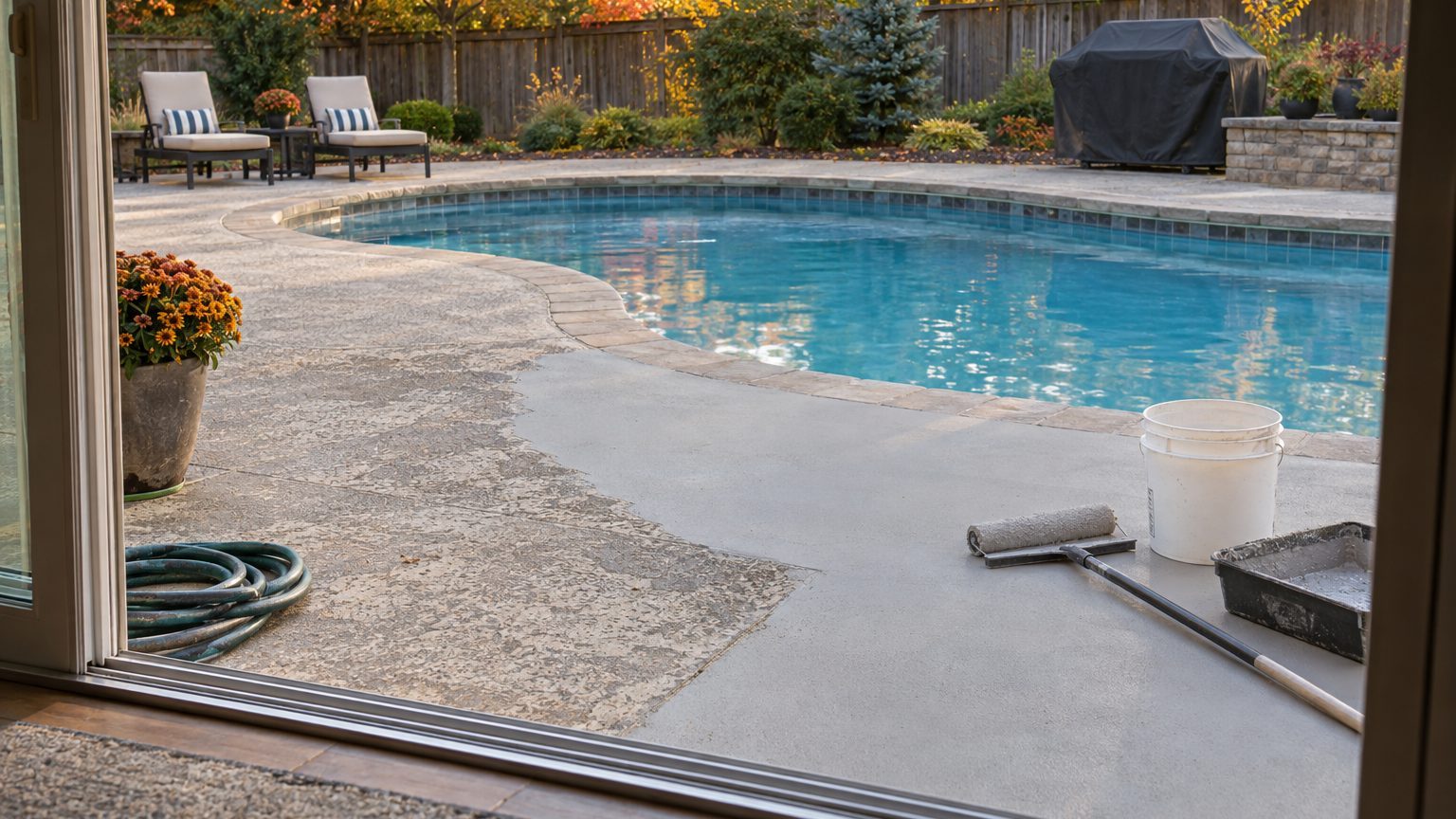
- Size: a deck near 10×12 feet is a one-weekend job. Anything you cannot finish in one pour or one day is a no-go.
- Condition: stable hairline cracks and surface wear are a go. Settling, hollow areas or active cracks are a no-go.
- Product: acrylic roll-on or a patch-and-recoat is a go. Stamped overlay is a no-go.
- Weather: Keystone Kool Deck instructions call for 50°F and rising, and no hotter than 90°F. Check your product’s own data sheet.
- Tools: you need a pressure washer, a trowel or roller, a sprayer for knockdown, and masking for coping and drains.
SUNDEK lists the process as prepare and repair, clean and prime, mix, apply, then cure and seal. In practice, mask coping, drains and expansion joints first. Repair cracks and spalls, then degrease and etch the slab so the overlay has a rough profile to grip. Rinse until the runoff is clear. Apply the bonding primer, mix only what you can place before it stiffens, and texture while the surface is workable. Seal after the cure window and add non-slip grit to the sealer.
Peeling usually traces to prep: oils or old sealer left on the slab, or no profile. The next cause is heat, since a mix applied in midday sun can set before it cures. Mixing too thick causes craze cracking, and the Keystone Kool Deck instructions put the best surface at no more than 1/8 inch thick. Slick surfaces come from glossy sealer without additive. Filling expansion joints causes cracks in the overlay above them.
How Do You Repair Texture on a Pool Deck?
Match the repair to what the surface is doing. Three conditions cover nearly every worn deck:
- Worn smooth: the surface is intact but feels slick, and water beads on it. Clean, etch, re-spray knockdown or roll on a non-slip coating, then seal with additive.
- Flaking: a scraper lifts the coating in sheets. Scrape back to a sound edge, feather it, prime, then recoat the whole field so the color matches.
- Spalled: the top skin has scaled off and aggregate shows. Chip out loose material, brush on bonder, patch, then re-texture.
For patches, E-Z Patch 2 Pool Deck Repair is a texture-matching option. Trowel about 1/4 inch thick over a bonder mixed at 1 part liquid cement bonder to 3 parts water. A 1 lb. jar covers about 1 square foot at that depth, and a 50 lb. pail covers about 65 square feet. It comes in 24 colors, with Sand Buff the most commonly used. For a color match, photograph the deck from about 2 feet away, or mail a piece at least 1 inch by 1 inch. Prices run from $36.25 to $475.56 by size. Keep foot traffic off for at least 24 hours and furniture off for 3 days, and allow 28 days for the cement to cure.
Re-texture with a spray knockdown for large areas, or drag a stiff broom across a fresh patch for a broom finish. Mix a non-slip additive into the sealer when you want grip without changing the look. Then test: wet the repaired area and walk it barefoot next to an untouched section. If the patch feels slicker, add more grit before the sealer cures.
Should You Resurface or Replace a Pool Deck?
Resurfacing works when the slab is stable and the damage sits on top. Check the deck before you buy anything:
- Cracks: hairline and stable is fine. A crack wide enough to catch a coin edge, or with one side higher, points to movement.
- Hollow spots: tap the slab or drag a chain over it. A hollow sound means delamination.
- Spalling: count the pits and scaled areas. A few are patchable.
- Trip hazards: lipped edges at joints can be ground or patched, but they flag movement.
- Drainage slope: water should run away from the pool and the house, not pond.
- Moisture: tape a plastic sheet to the slab overnight. Condensation under it means moisture is rising through the concrete.
Replace when the structure has failed. Settling, heaving, a slope that sends water toward the house, and widespread cracking all keep moving under an overlay and show through within a few seasons. An overlay only hides surface wear. It cannot stabilize a slab that is sinking or lifting.
Frequently Asked Questions
How long does pool deck resurfacing last?
With proper cleaning and maintenance, a SUNDEK surface can last 10 to 15 years, and the company has seen surfaces last up to 25 years. Thin acrylic coatings wear out sooner. Prep quality, pool chemical exposure and freeze-thaw cycles decide the rest.
Can you resurface a pool deck without draining the pool?
Yes, and you should leave it full. Draining an in-ground pool can damage the shell where groundwater is high. Mask the coping, cover the water, and keep acid wash rinse and overlay debris out of the pool.
Can you resurface over cracked concrete around a pool?
Stable hairline cracks can be repaired and covered. A moving crack reflects through any overlay, so a deck with active cracks needs structural work first.
How long before you can walk on a newly resurfaced pool deck?
Keystone Kool Deck instructions say to stay off for 48 hours, with light walking after 3 days, normal walking after 14 days and heavy patio furniture after 28 days. Acrylic coatings and patch products set faster, so follow the data sheet for your product.
Sources: metalamericaconcrete.com | e-zpatch.com | newageconstructiongroup.com