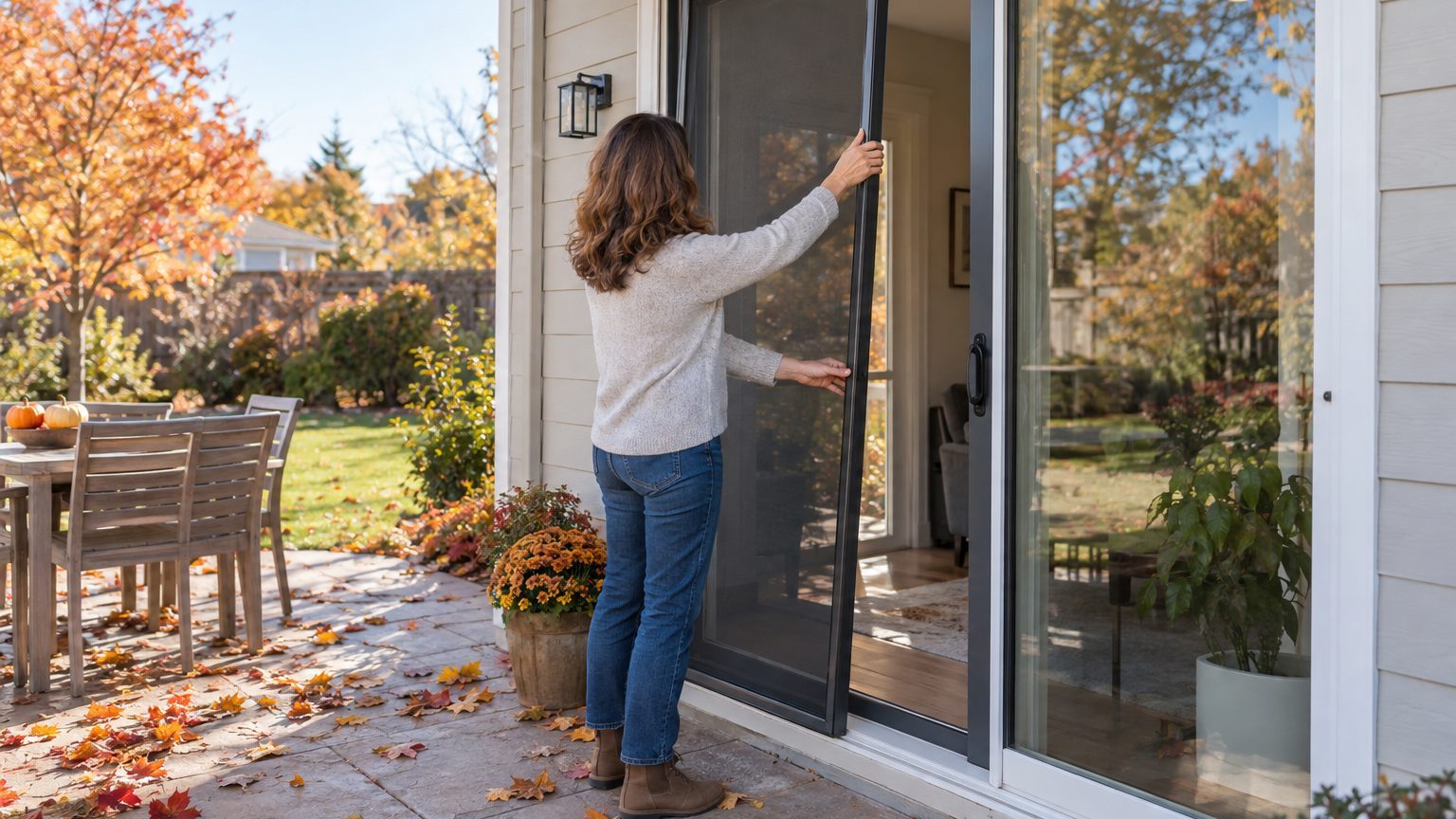
Most sliding screen doors run 36 to 48 inches wide and 78 to 81 inches tall. That range is the trap, because a “standard” panel that misses your track by a quarter inch will bind, rattle, or never go in. A sliding door replacement screen has to match the track system, not just the doorway.
Measure the old panel, not the opening, whenever you can.
Measuring a sliding door replacement screen
Lift the old door out with its rollers still attached and lay it flat. Height is the measurement that causes the most returns, so take it in three places: left, middle, and right. Use the shortest number. Some installers then deduct about a quarter inch so the panel can be tilted up into the top channel and dropped onto the bottom track.
Width gets the same treatment, measured at the top, middle, and bottom of the frame. In most homes the screen panel is roughly the width of the glass door that slides beside it, which makes a useful sanity check. If your numbers differ by more than a fraction of an inch from one point to the next, the frame has racked out of square, and you’ll want to know that before you order.
Use a rigid metal tape, because a bending one will lie to you.
The top header matters too. Run a finger along the inside of the upper track and note whether it is T-shaped or U-shaped, since that shape decides how much clearance the panel needs. Common rules of thumb for a missing-door measurement add about 3/8 inch to the height for a T-shaped header and 1/8 inch for a U-shaped one. Treat those as starting points and confirm against the manufacturer’s spec sheet.
No old door to measure? Check the opening for square by measuring the diagonals (they should match), then measure from the top of the roller track to the lower edge of the top channel, and from the jamb edge to about an inch short of where the fixed glass begins. Photograph the track profile and the old roller style, if any remnants survive. Suppliers who cut panels to order will often ask for exactly those pictures.
Replace the frame, or just re-screen it?
A torn screen on a sound frame is a $20 afternoon. A bent, warped, cracked, or rusted frame is a different story, and so is a door that keeps jumping the track after you’ve fitted new rollers. At that point you’re paying for repairs on something that’s already failed.
Frame construction explains a lot of those failures. Roll-formed aluminum doors, made from thin sheet metal, cost the least, and their corners are the weak point: once the friction-fit corners loosen, the door sticks and jams. Extruded frames cost more and generally last longer because the corners are joined with screws or mitered inserts.
Then there’s the mesh. Standard fiberglass is the cheapest and clearest to see through, and most sliding doors ship with it. It typically lasts somewhere between 8 and 15 years, depending on sun and use. Aluminum mesh holds its shape and resists tearing, with a lifespan often quoted at 15 to 25 years, but it dents or creases when struck and costs more per square foot. Retail pricing puts fiberglass at roughly $0.50 to $1.50 per square foot and aluminum at $1.50 to $2.50.
Dogs change the math. Pet-resistant mesh is vinyl-coated polyester, advertised as about seven times stronger than fiberglass, and it runs roughly $2.50 to $4.00 per square foot. The tradeoff is a slightly tighter weave, which cuts visibility and airflow a little.
Standard fiberglass will not survive a determined dog.
Two specialty meshes are worth a look if your door has a specific problem. Solar mesh cuts glare and heat on a west-facing slider. No-see-um mesh has an extremely fine weave that blocks gnats and midges, at the price of some airflow.
Installing the new panel
Before the new panel goes in, vacuum the track and wipe it down. Check it for dents, because a crimped rail will ruin a brand-new door within a season. Retract the roller adjusters until the wheels sit high, which gives you the clearance you need.
Hold the panel by its sides, tilt the top edge up into the upper channel, and swing the bottom in until the rollers drop onto the lower track. Slide it a few times. Most panels have an adjustment screw near each bottom corner, and turning them raises or lowers that side until the gap against the jamb is even from top to bottom.
Check for daylight along the vertical edges. A gap wider than a pencil’s thickness invites insects, while a panel that scrapes the jamb will wear out its rollers early. If the door drifts toward one side when you let go, one roller is set higher than the other.
Finish with a latch check, since a loose or misaligned catch is the most common reason a sliding screen door gets left ajar. If you’re rescreening a frame yourself rather than swapping the whole panel, buy about 20 percent more mesh than the square footage suggests to cover overlap and trimming. Pet mesh is stiffer than fiberglass and won’t stretch to hide small mistakes while you roll the spline, so use a sharp new blade and go slowly.
One last tip from the installers’ side: write your final measurements on a strip of tape inside the door’s track, where they’ll survive the next time someone needs a replacement.
Sources: tencom.com | fixingscreens.com | aronwindows.com