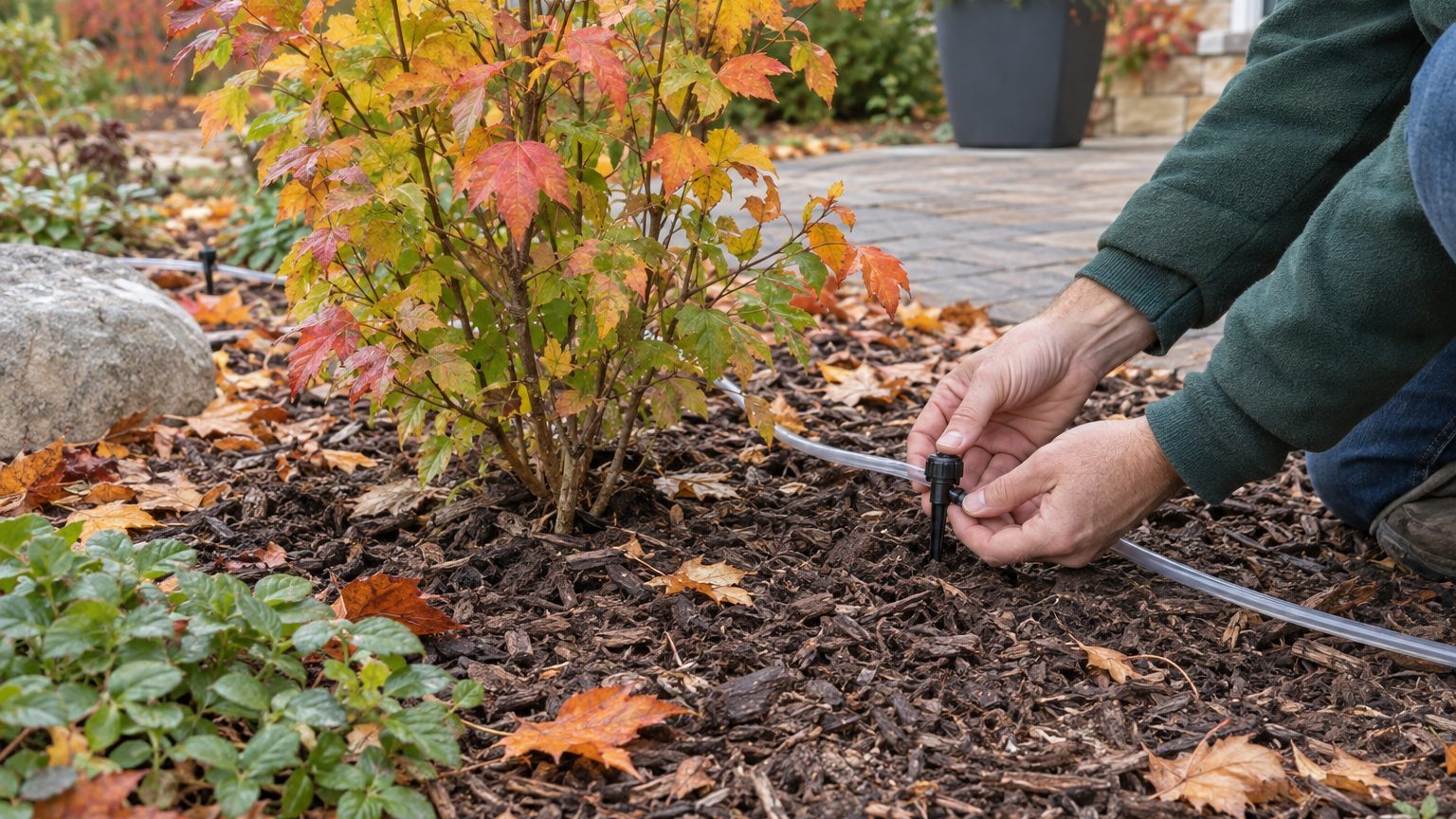
Four numbers cover most of what sits on a garden center shelf: 1/2, 1, 2 and 4 gallons per hour. Emitting devices for widely spaced plants are normally attached to polyethylene tubing, and most deliver one of those four rates at their design operating pressure. That makes flow rate the first decision when you buy drip Irrigation system emitters. A wrong choice drowns a seedling or starves a maple.
Placement matters just as much as the emitter itself.
Point-source, inline, and pressure-compensating: what each one does
Point-source emitters deliver water to one spot, which makes them the right tool for shrubs, trees, containers and perennials. Common styles include a self-piercing barb, a 10/32 threaded fitting and a 1/2-inch female pipe thread. Button emitters are the popular homeowner version, and they can be swapped for higher or lower flow models as plants mature. Flag emitters add a side outlet, so you can extend 1/4-inch distribution tubing to the plant’s location.
Line-source emitters work differently. The tubing itself does the emitting, either as twin-wall tubing or as drippers inserted or molded into the line at preset spacings such as 6, 9, 12 or 18 inches. Vegetable rows and raised beds are their natural home, since the plants are close enough that a continuous strip of moisture beats individual dots.
Then there is pressure compensation, which sounds like a luxury and often isn’t. Pressure varies across long zones or landscapes with elevation changes, and pressure-compensating emitters keep flow nearly identical from the first emitter to the last. Basic emitters don’t. Their ratings are listed at 15 PSI, so flow runs lower at 4 PSI and higher at 40 PSI. On a flat 20-foot bed you may never notice, but on a sloped side yard the plants at the bottom of the hill can get twice what the plants at the top do.
Emitter colors only mean something inside a single brand’s product line.
Matching flow rate to soil and plant
Soil sets the baseline. Lower flow rates such as 0.5 GPH suit dense or clay soils, while 1 to 2 GPH works better in sandy soils or for larger plants. The reason is physics: water moves down by gravity and sideways by capillary action, and in sandy soil gravity wins. Clay soaks slowly and spreads wide, so a gentle drip gives it time to absorb.
Plant size comes next. Small plants and containers want 0.5 to 1 GPH, shrubs and vegetables want 1 to 2 GPH, and trees want multiple higher-flow emitters.
Trees are where most people undercount. Oklahoma State University Extension notes that a single 1 gph emitter could supply the water a tree needs, but root development is better promoted by splitting that flow among three or four emitters. Their worked example uses four 2 gph emitters, which deliver the required 18.8 gallons in 2.4 hours. The math is simple: gallons needed, divided by the number of emitters times the flow rate of each, gives you run time in hours. A university extension expert gives a similar benchmark for big canopies, suggesting four 2 gal/hr emitters per plant.
Your water supply caps the whole system. A standard outside hydrant delivers about 5 gpm, enough to run roughly 300 point-source emitters at 1 gph each. Most backyards never come close, but a sprawling garden with hundreds of 2 gph emitters can blow past the limit and leave the far end of the line dry.
Where the emitters go
Start with the easy beds. Iowa State University Extension advises that in vegetable gardens and annual flower beds, emitters go every 12 inches, or one per plant when plants are widely spaced. Perennials get an emitter at every plant. Tomatoes and peppers, which sit far apart, are better served by a dedicated emitter at each base than by a continuous line.
Shrubs need more thought. Small shrubs under 5 feet get an emitter on either side, while large shrubs get one every 3 or 4 feet around the plant, about 2 feet from the base. Trees follow the same logic at a larger scale, with emitters about every 4 feet within the tree’s dripline.
One emitter beside a young tree rarely does the job.
Roots spread outward as a tree grows, so the watering zone has to follow them. Utah State University Extension says that as trees get larger, rings of drip need to be added so emitters are spaced every 3 to 4 feet. There is a trade-off at planting time. Emitters need to sit close enough that small roots can reach the water, but not so close that they limit root development or wet the plant directly. For grapevines, emitters typically go about 12 inches from the trunk. Soil type adjusts the spacing too. In sandy ground, closer spacing of 6 to 9 inches helps water spread sideways before it sinks past the roots, while most loamy soils do well with a standard 12 inches.
Anchor the tubing once it’s in place. Wind, animals and routine garden work can shift loose lines, and a moved line means emitters no longer water the spot you intended. A few landscape staples per bed keep every emitter where you aimed it.
Sources: yardandgarden.extension.iastate.edu | dripworks.com | gardenbasics.substack.com